Part 3b of Iterating in the Dark:
Organizational Blindness in AI Evaluations
Knowing where to improve
← Part 3: Better "Evals" Beats Better Dev | Series Index
So far we've talked about V (value) as a single number. But in practice, value is composed of multiple factors.
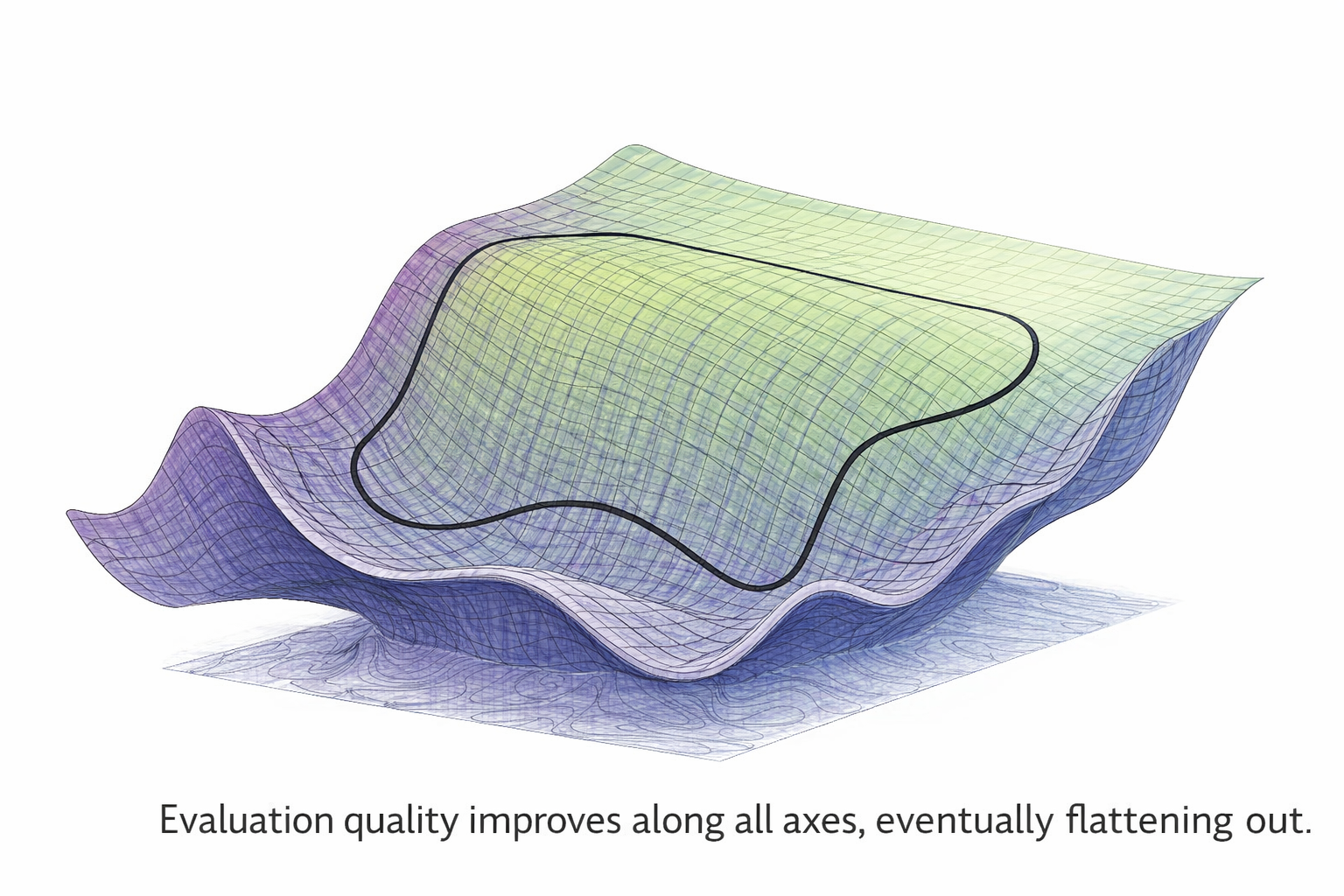
Think back to the loss profile from Part 1:
This multi-dimensional surface maps to a scorecard—a breakdown of value into measurable components:
Each dimension is an axis along which we can improve. And critically, if we can measure these dimensions reliably, we know where to focus engineering effort.
This is the second way better eval leads to better quality: not just through better deployment decisions, but through directed improvement.
Consider two scenarios:
Scenario A: Poor scorecard measurement
Scenario B: Good scorecard measurement
Conversely, if we cannot measure scorecard metrics properly, we cannot understand where to act. We're flying blind—iterating toward a random target, as we discussed in Part 1.
And yes, you guessed it - every dimension, every metric is a random variable, just like our "value".
Sometimes it's hard to come up with a good scorecard from first principles. What dimensions actually matter to customers? Is latency more important than fluency? Does accuracy matter more than compliance? There's an empirical shortcut:
This is extremely powerful. You don't necessarily need to know in advance exactly what matters. You can discover it empirically. And you don't need a lot of data to begin to see patterns. it just takes a study and sit down with some design partners or customers.
For example, you might hypothesize that latency matters a lot. But after measuring, you discover that customers don't complain about latency until it exceeds 5 seconds—below that, they don't notice. Meanwhile, every 10% improvement in German fluency correlates with a 15% increase in adoption among German-speaking users.
Now you know: optimize German fluency, not latency. Without the correlation analysis, you might have spent months shaving milliseconds off response time while the real problem went unaddressed. You dont need a thousands data points for this - after a few dozens you'll start having a good insight on where to focus.
Next: Part 4: Where and Why "Eval" Goes Wrong — Where evaluation uncertainty comes from